
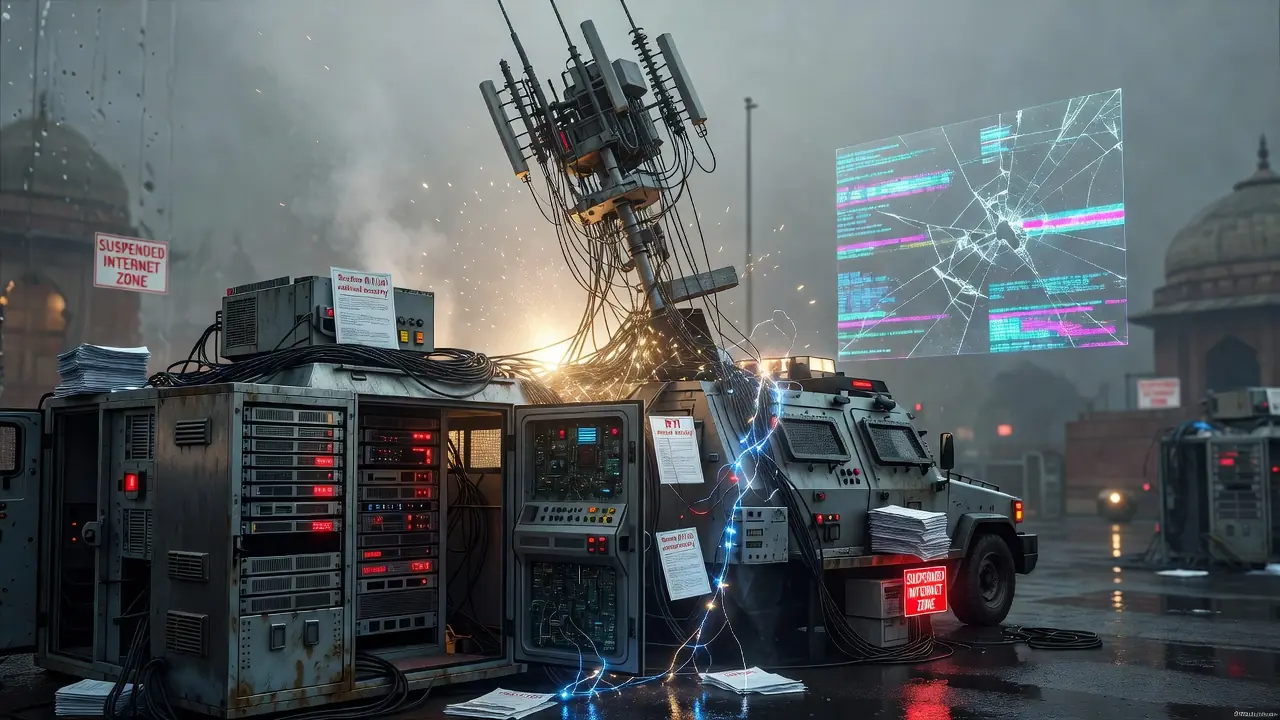
Delhi Police has spent ₹161.27 crore acquiring 34 signal-jamming systems since mid-2024, yet refuses to disclose how officers decide when to switch them on, according to a new investigation by the Internet Freedom Foundation (IFF). The digital rights group's analysis of Right to Information replies exposes a procurement trail that is partly documented and an operational one that is almost entirely opaque.
What was bought, and from whom
The force's provisioning and logistics unit disclosed that it purchased 30 vehicle-mounted jammers on 23 May 2026 for ₹138.42 crore, and four smart jammers designed to counter aerial remote-controlled explosive devices on 4 July 2024 for ₹22.85 crore. Both acquisitions went through Electronics Corporation of India Ltd on a nomination basis, bypassing open tenders - a route permitted under the Cabinet secretariat's framework, which names ECIL and Bharat Electronics Ltd as the only approved public-sector suppliers of such equipment. The vehicle-mounted units reportedly operate across a 20MHz to 6,000MHz range, a band wide enough to touch mobile networks, Wi-Fi, Bluetooth, GPS and FM radio simultaneously. That breadth is precisely why independent scrutiny of their deployment matters: a jammer's real-world footprint depends on power settings, terrain and intent, none of which the police have detailed.
A security unit that will not say what it holds
The jammers sit with Delhi Police's security unit, tasked with protecting designated individuals under the government's "Yellow Book" protocol - a manual that is itself not public. When IFF asked for an inventory, the list of officers authorised to approve deployment, and records from 2023 to 2026, the unit invoked Section 8(1)(a) of the RTI Act, citing national security and "VVIP security interests." Yet the logistics unit had, a day earlier, freely disclosed quantities, models, dates and costs for the same equipment. IFF argues this inconsistency undermines the confidentiality claim: if procurement details can be published, it is unclear why basic deployment oversight cannot be. A third unit, in north-west Delhi, said no standing order or circular governing jammer use even exists, and directed several queries elsewhere - leaving the three offices effectively pointing at one another.
Protests, dead networks and unanswered questions on 112
The disclosures land against a backdrop of connectivity failures during recent demonstrations. Mobile networks reportedly went down around Jantar Mantar on 20 and 22 July 2026, during a weeks-long student sit-in, after the home ministry ordered an internet suspension in a roughly 1.5km radius - though voice calls, not just data, were also reported to have failed, fuelling speculation about portable jammer use that police have neither confirmed nor denied. A further suspension covered a 4km radius ahead of an October protest. None of the three police units told IFF whether the force had assessed what jamming might do to calls to 112, India's emergency number, or to nearby hospitals - a gap that echoes warnings from regulators elsewhere, including the US Federal Communications Commission, that jamming equipment can block emergency communications regardless of its intended target.
Rules exist, but enforcement is invisible
The Telecommunications Act, 2023 restricts possession of jamming equipment to those with government authorisation, and the Cabinet secretariat's 2025 Jammer Guidelines require deployment records and measures against interference with ordinary networks. On paper, safeguards exist. In practice, IFF found no public mechanism showing how those rules apply to crowd control rather than VIP protection, nor any figures on how often Delhi's jammers have actually been used. The organisation has filed fresh RTI applications with ECIL covering equipment supplied since 2019, including systems reportedly deployed during the 2023 G20 summit, and says it will appeal the current responses. Until clearer answers emerge, the ₹161.27 crore outlay stands as a rare instance where the purchase price is known but the public cost - in terms of oversight and accountability - is not.