
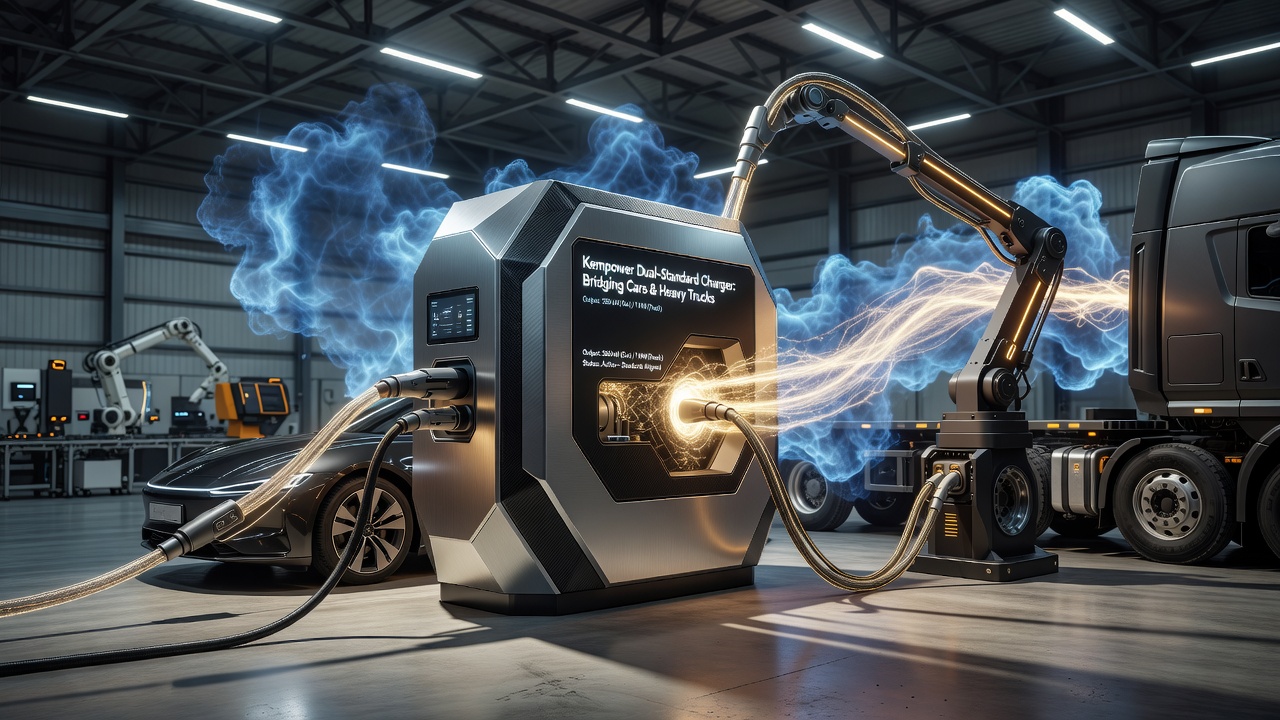
Kempower has introduced a charging unit designed to solve one of the most expensive problems in electric transport infrastructure: the fact that cars and heavy trucks currently need separate charging systems. The new Mega Satellite Flex supports both the established CCS standard, delivering up to 560 kW, and the emerging Megawatt Charging System, capable of pushing up to 1.2 MW to a single vehicle. It was shown publicly for the first time this week at the ACT Expo, during Kempower's Unplug & Recharge event for customers and partners.
The timing reflects where the industry actually stands right now. CCS remains the dominant standard for passenger electric vehicles across North America and Europe, while MCS is still being built out specifically to serve electric trucks and other heavy-duty vehicles that require far higher power delivery to keep freight schedules realistic. Rather than forcing site operators to pick a side, or build two separate systems, Kempower's approach lets a single dispenser serve both categories of vehicle from day one. For fleet operators and charge point owners weighing which hardware fits their long-term plans, it can help to see the comparison between single-standard and dual-standard units before committing capital to a site build. see the comparison
Why One Dispenser for Two Standards Matters
Building charging infrastructure is capital-intensive, and the return on that investment depends heavily on utilization. A site that can only serve passenger cars sits idle whenever a truck needs power, and vice versa. By supporting both CCS and MCS through the same unit, up to 700 amps for CCS and 1,500 amps for MCS, Kempower is betting that operators will get more consistent use out of every stall they install. That also protects against a scenario familiar to anyone who has watched infrastructure standards evolve: building for today's dominant protocol only to find it insufficient a few years later when demand shifts.
The unit is also built with an eye toward where passenger EVs are heading. Many newer models run on 800-volt architectures, which allow for substantially faster charging than the 400-volt systems that have been standard for years. A charger that can't deliver the current those vehicles are designed to accept becomes a bottleneck rather than a convenience. The Mega Satellite Flex is designed to keep pace with that shift rather than requiring a second hardware refresh later.
Practical Details for Operators
- CCS cable length of 5 meters (16.4 feet), suited to passenger vehicle charging positions
- MCS cable length of 2.7 meters (8.86 feet), matched to truck connector placement
- Optional integrated payment terminal for direct consumer transactions
- Compatibility with Kempower's existing distributed charging architecture, avoiding a full infrastructure overhaul
That last point matters for operators who have already invested in Kempower's power distribution systems. Rather than ripping out existing infrastructure to add megawatt capability, they can integrate the new dispenser into what's already on site, reducing both cost and downtime during installation.
What Comes Next
The Mega Satellite Flex is expected to reach the market in North America and Europe in July 2026, giving operators time to plan sites around a technology still in its early commercial phase. MCS adoption will depend on truck manufacturers standardizing around it and on charging networks proving the economics work at scale. A dual-standard unit like this one lowers the risk of that bet by letting a single site serve whichever vehicles show up, cars or trucks, without forcing an early commitment to one charging future over another.